Snipe
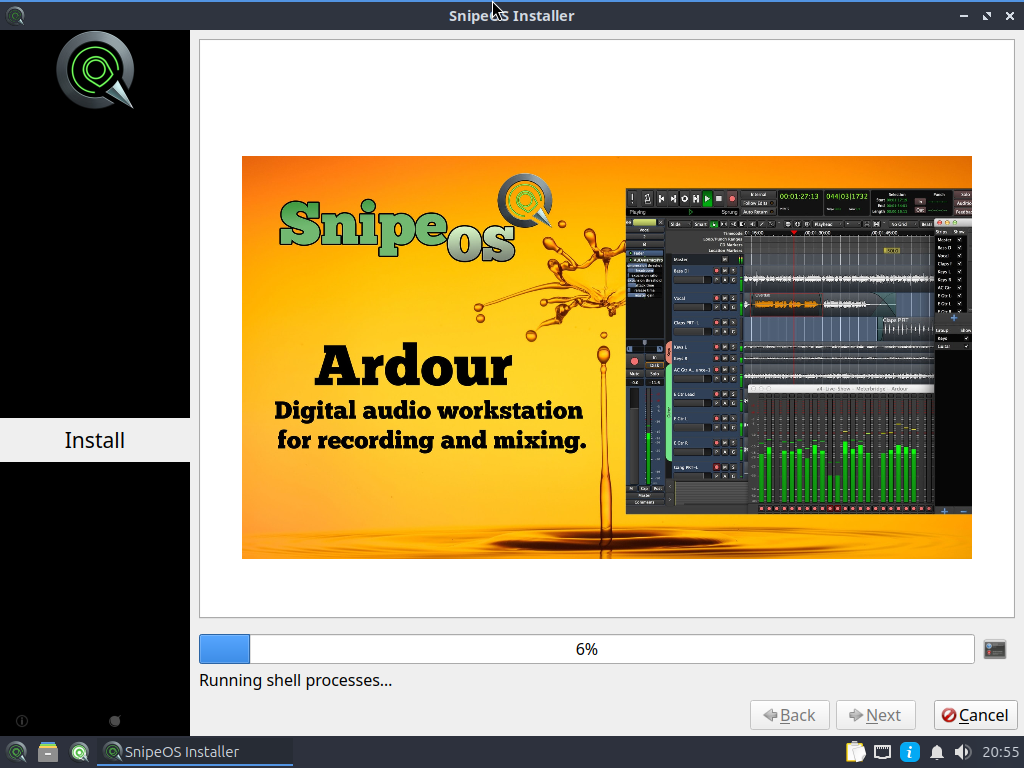
SnipeArdour
Ardour is a professional digital audio workstation, the free software peer of tools like Pro Tools and Logic in the recording and mixing domain. It offers unlimited audio and MIDI tracks, non-destructive and non-linear editing, a full mixing console with buses, sends, and plugin inserts, automation of essentially every parameter, support for LV2, VST3, and LADSPA plugin standards, comprehensive routing through JACK or ALSA, and session interchange with other tools. It is used to record albums, mix films, and master podcasts, and it is developed by people who do those jobs.
SnipeOS ships Ardour with its first-run flow intact and validated: the welcome and GUI scaling dialog, audio and MIDI setup against ALSA, default session folder selection, and new session creation are all part of the fresh-install success gallery, which matters because a DAW that cannot reach the sound hardware is a paperweight, and the ALSA path was explicitly exercised during QA. For podcasters, musicians, and video producers who need real multitrack control (recording a band, editing a two-hour interview with per-speaker processing, mixing a film soundtrack against picture), Ardour is the deep end of the SnipeOS audio story. Give it the recommended 4 GB and an SSD and it is a serious studio; the demands scale with track and plugin count, so lighter sessions remain feasible on lesser machines.